
By Dr James Whitehead – Nature Sense, University of Sussex
Over the past couple of years Nature Sense has been helping the Charity monitor two locations on Gravetye Estate. These are locations where we take nature’s pulse by monitoring which organisms are present and which are absent.
The core of our monitoring is done passively using acoustic monitoring equipment to track birds and camera traps to monitor mammals, combined with occasional vegetation surveys. However, throughout the year we also receive valuable help from Citizen Scientists who help us to monitor butterflies, pollinators, and even earthworms.
A few weeks ago, we did a deep dive into the data we had gathered to understand how the locations were faring.
To understand how woodland-, farmland- and scrubland associated birds are fairing at each site throughout the year we used our own “Health Indexes”. We always see a seasonal decrease in these indexes during the winter, but when we compare the values from this year to last year, when monitoring began, we can see they are largely stable.
When we compare these habit-specific indexes to other sites across the Nature Sense network, we see that where Gravetye really holds its own is woodland birds. One notable member of Gravetye’s bird community is the Marsh Tit. This undeniably miss-named bird is a woodland specialist, although it does sometimes venture into gardens. They tend to nest in existing tree-holes, often created by woodpeckers. Lesser Spotted Woodpeckers are the UKs rarest woodpecker, and they show up at Gravetye too. In fact, we think there is at least one breeding pair near our monitoring station in Sweet Briar. However, it is likely to be the holes left by their larger cousin, the Great Spotted Woodpecker, which are of more widespread use by Marsh Tits. Unlike the Lesser Spotted, which can only drill into dead wood, the more powerful Great Spotted Woodpecker can power-drill its way into living wood, even oak.
The farmland and scrubland assemblages at Gravetye are not currently doing quite as well as those at other sites. However, new management plans with a distinct rewilding flavour are currently being deployed. One common feature of rewilded landscapes is a significant increase in scrub development. We will be there to monitor how this impacts the “health indexes” and expect to see an increase in species such as Yellowhammer, Spotted Flycatcher and Bullfinch, all already recorded at Gravetye, although infrequently.
Let’s take a moment to appreciate the more active birds at Gravetye though. A typical day at Gravetye starts with a dawn chorus from 6-8am, with the most vociferous bird being the Goldfinch. Goldfinches carry on singing throughout the day and are only overtaken in their activity by late afternoon by Great Spotted Woodpeckers who are particularly active at around 18:00-19:00. Dunnock are late joiners to the dawn chorus but can be heard throughout the day. In the late evening from 20:00-22:00 Song Thrushes serenade the coming night. Anyone who has experienced a Song Thrush’s nighttime song will be familiar with its beauty and mournfulness. With the arrival of night comes one of Gravetye’s most active birds; the Tawny Owl. These birds are so active at Gravetye that they have even shown up in our camera trap footage at Gravetye making use of the tree-guards at Stone Wood for perching.
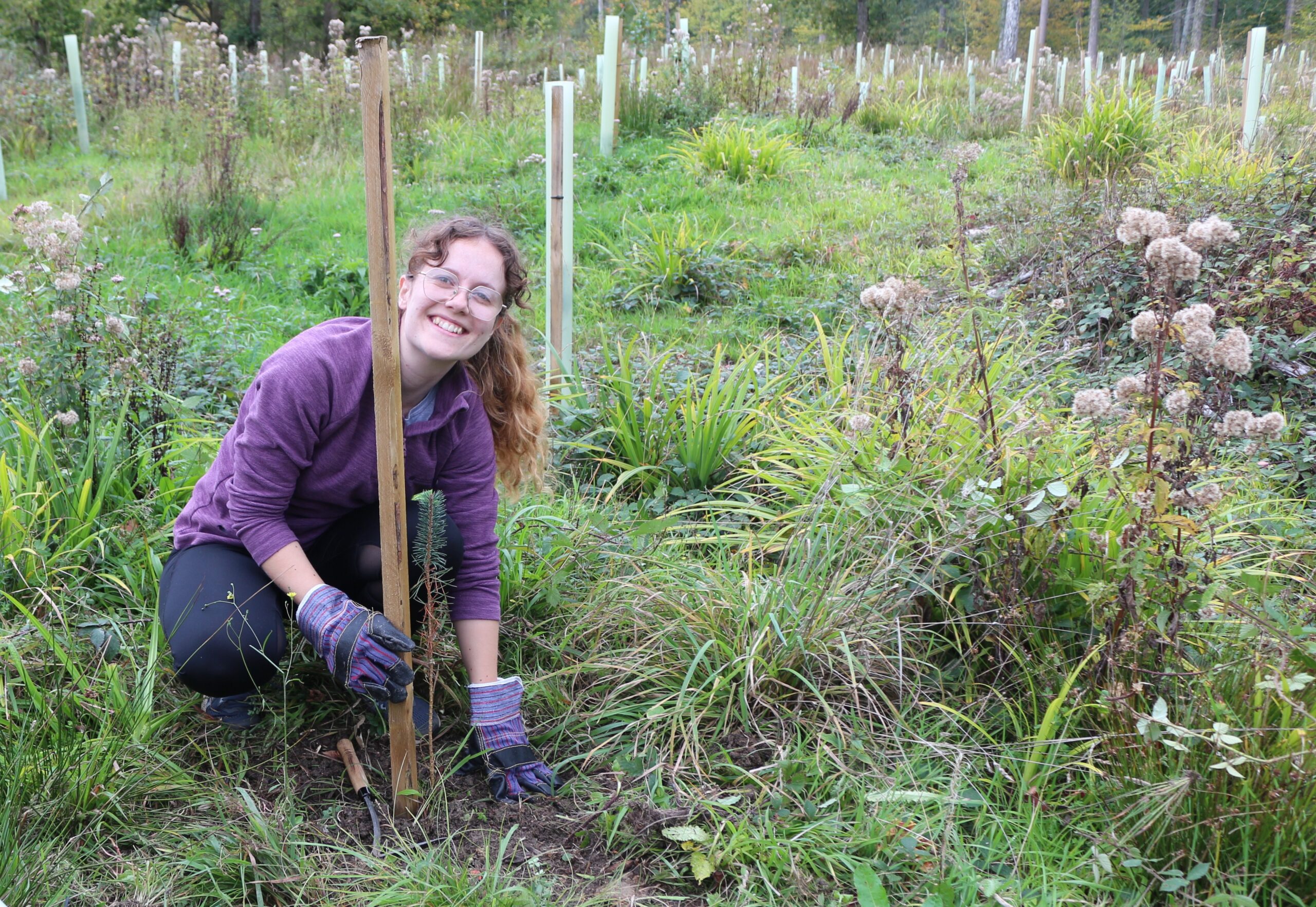
The area of recently planted woodland at Stone Wood is rapidly changing, over the past couple of years the bare ground has been colonised by a variety of large ruderal plants. Pendulus Sedge led the charge to colonise bare soil and has been followed by forbs such as American Willowherb, Creeping Thistle and Fleabane, providing valuable nectar sources for invertebrates. This developing flora is also having an impact on the mammals seen at this monitoring site. We recently captured footage of large Fallow Deer bucks spending extended amounts of time next to our monitoring station. Fallows are common across Sussex, and Gravetye is no exception, although these are some of the largest we have thus seen on the estate. A few months ago, the shorter sward would likely have left any such deer feeling rather exposed.
2026 was one of the best years for adult butterflies in the past 16 years. However, the hot weather also threatened some drought-susceptible species such as the Ringlet, Speckled Wood, and Green Veined White. It is therefore fantastic that our Citizen Scientists recorded substantial numbers of Ringlets at Sweet Briar, as well as several records of Specked Woods at Stone Wood. In line with national trends, we saw relatively high numbers of Small Copper and Painted Lady butterflies.
The species assemblages at both monitoring areas contain a mix of generalists (such as Meadow Brown, Painted Lady), but also species who depend on the specific plants present at each site. Sweet Briar with its tall sward of grasses contains a range of grass-dependant species including Ringlet and Small Skipper. The recently developed flora at Stone Wood is already playing host to many Common Blues, indicating substantial nectar sources are available.
2026 saw the arrival of vast numbers of Clouded Yellow butterflies, making it one of the “Clouded Yellow Years” which happen about once per decade. It is interesting that Clouded Yellows were only recorded at Stone Wood, probably due to the far higher prevalence of leguminous foodplants, which are unavailable at Sweet Briar. Our Citizen Scientists also generally saw a higher abundance of pollinators at Stone Wood than Sweet Briar, no doubt due to the broader availability of nectar sources. Citizen Scientists recorded the functional groups of pollinators interacting with flowers at the monitoring sties. The proportions of these functional groups did not differ significantly, with one exception being the high proportion of “Small Insects” (<3mm) seen at Sweet Briar. This may be due to the types of flowers present; the most abundant small insect generally seen is the “Pollen Beetle” which is attracted to yellow flowers. One of the flowering plants seen even in the most grass-dominated habitats is Ragwort, and we suggest that it was the bright yellow flowers of Ragwort at Sweet Briar which causes this variation.
The results from this season’s earthworm surveys are still being processed, however, preliminary results suggest an abundance of juvenile worms at Sweet Briar, with few adults. Numbers of both juveniles and adults were generally low at Stone Wood. This summer was exceptionally hot, and across the Nature Sense network we have evidence of its below-ground impacts. During the first surveys of the season, we saw worms still wrapped in torpor balls and even some husks of dried-out worms. By the time we surveyed Gravetye, most soil had largely been rewetted by rain, however, it is likely that the absence of adults is a result of high mortality over the preceding months.